Buy esport-game.eu ?
We are moving the project
esport-game.eu .
Are you interested in purchasing the domain
esport-game.eu ?
domain@kv-gmbh.de · 0541-91531010
Buy esport-game.eu ?
Is the following relation transitive?
To determine if a relation is transitive, we need to check if whenever (a, b) and (b, c) are in the relation, then (a, c) is also in the relation. If this holds true for all elements in the relation, then the relation is transitive. **
Why is this relation not transitive?
This relation is not transitive because transitivity requires that if a is related to b and b is related to c, then a must be related to c. In this relation, it is possible for a to be related to b and b to be related to c, but a is not related to c. This breaks the transitive property and makes the relation not transitive. **


Similar search terms for Transitive
Top-Angebote
Products related to Transitive:
-
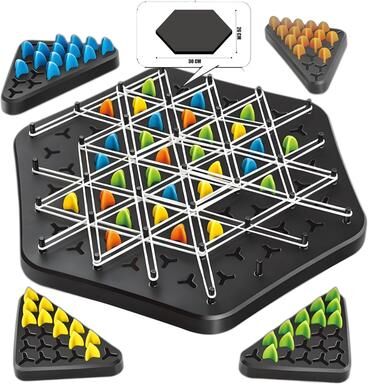
Uplift Picks Triangle Strategy Board Game Chain Chess Family Fun Logic Game 30x26 CmBring excitement to your game nights with this engaging strategy board game designed to challenge your thinking and spark fun competition. Perfect for both kids and adults, this family board game combines logic, planning, and interactive play. Its...57,98 $*Shipping: 0,00 $Secure redirect to the provider
-
Multisell Products Hub Easy To Play Chess Board Game Toy, Educational Strategy Table Games Easy To Play Chess Board Game Toy, Educational Strategy Table GamesEngage Your Mind with a Classic Chess Board Game The Chess Board Game Toy is a timeless strategy game that offers endless fun for both beginners and experienced players. Designed to be easy to play, this game is perfect for improving focus,...49,97 $*Shipping: 0,00 $Secure redirect to the provider
-
Uplift Picks Big Eat Small Tic Tac Toe Board Game Interactive Strategy Party Toy Big Eat Small Tic Tac Toe Board Game Interactive Strategy Party ToyChallenge minds and spark laughter with this big eat small board game that adds a clever twist to classic tic tac toe. Designed for kids and adults alike, it blends simple rules with strategic thinking to keep every round exciting. Players must...45,50 $*Shipping: 0,00 $Secure redirect to the provider



-
What are transitive verbs in English?
Transitive verbs in English are verbs that require a direct object to complete their meaning in a sentence. This means that the action of the verb is done to someone or something. For example, in the sentence "She ate the apple," the verb "ate" is transitive because it requires the direct object "the apple" to make sense. Transitive verbs are an important part of constructing clear and complete sentences in English. **
-
Is this relation symmetric and transitive?
To determine if a relation is symmetric, we need to check if for every (a, b) in the relation, (b, a) is also in the relation. To determine if a relation is transitive, we need to check if for every (a, b) and (b, c) in the relation, (a, c) is also in the relation. If a relation is symmetric, it means that for every (a, b) in the relation, (b, a) is also in the relation. If a relation is transitive, it means that for every (a, b) and (b, c) in the relation, (a, c) is also in the relation. You would need to provide the specific relation in order for me to determine if it is symmetric and transitive. **
-
What are transitive and intransitive verbs in Japanese?
Transitive verbs in Japanese are verbs that require a direct object to complete their meaning. For example, the verb "taberu" (to eat) is transitive, as it requires a direct object such as "pan" (bread) to complete the action. Intransitive verbs, on the other hand, do not require a direct object and express an action that is performed without affecting another object. For example, the verb "aruku" (to walk) is intransitive, as it does not require a direct object to complete its meaning. Understanding the difference between transitive and intransitive verbs is important for constructing grammatically correct sentences in Japanese. **
-
Is a purely reflexive relation also transitive and symmetric?
A purely reflexive relation is transitive because for any element a, if (a, a) is in the relation and (a, a) is in the relation, then (a, a) must also be in the relation. However, a purely reflexive relation is not symmetric because symmetry requires that if (a, b) is in the relation, then (b, a) must also be in the relation, which is not necessarily true for a purely reflexive relation. **


Is this relation reflexive, symmetric, reflexive and/or transitive?
To answer this question, I need to know the specific relation that is being referred to. Please provide the relation or the context in which it is being used so that I can accurately determine if it is reflexive, symmetric, reflexive, and/or transitive. **
What is the difference between transitive and intransitive verbs?
Transitive verbs are verbs that require a direct object to complete their meaning, while intransitive verbs do not require a direct object. For example, in the sentence "She ate the apple," "ate" is a transitive verb because it requires the direct object "the apple" to complete its meaning. In contrast, in the sentence "He sleeps," "sleeps" is an intransitive verb because it does not require a direct object. Intransitive verbs often describe actions that do not transfer to an object, such as movement or states of being. **
Top-Angebote
Products related to Transitive:
-
Uplift Picks Multiplayer Balloon Explosion Game Fun Family Tabletop Party Toy Multiplayer Balloon Explosion Game Fun Family Tabletop Party ToyGet ready for laughter, suspense, and surprise with this exciting balloon explosion game that keeps everyone on edge. Designed as a thrilling family tabletop party game, players take turns adding pressure until the balloon suddenly pops. This...30,98 $*Shipping: 0,00 $Secure redirect to the provider
-
Uplift Picks Triangle Strategy Board Game Chain Chess Family Fun Logic Game 30x26 CmBring excitement to your game nights with this engaging strategy board game designed to challenge your thinking and spark fun competition. Perfect for both kids and adults, this family board game combines logic, planning, and interactive play. Its...57,98 $*Shipping: 0,00 $Secure redirect to the provider
-
Is the following relation transitive?
To determine if a relation is transitive, we need to check if whenever (a, b) and (b, c) are in the relation, then (a, c) is also in the relation. If this holds true for all elements in the relation, then the relation is transitive. **
-
Why is this relation not transitive?
This relation is not transitive because transitivity requires that if a is related to b and b is related to c, then a must be related to c. In this relation, it is possible for a to be related to b and b to be related to c, but a is not related to c. This breaks the transitive property and makes the relation not transitive. **
-
What are transitive verbs in English?
Transitive verbs in English are verbs that require a direct object to complete their meaning in a sentence. This means that the action of the verb is done to someone or something. For example, in the sentence "She ate the apple," the verb "ate" is transitive because it requires the direct object "the apple" to make sense. Transitive verbs are an important part of constructing clear and complete sentences in English. **
-
Is this relation symmetric and transitive?
To determine if a relation is symmetric, we need to check if for every (a, b) in the relation, (b, a) is also in the relation. To determine if a relation is transitive, we need to check if for every (a, b) and (b, c) in the relation, (a, c) is also in the relation. If a relation is symmetric, it means that for every (a, b) in the relation, (b, a) is also in the relation. If a relation is transitive, it means that for every (a, b) and (b, c) in the relation, (a, c) is also in the relation. You would need to provide the specific relation in order for me to determine if it is symmetric and transitive. **
Similar search terms for Transitive
-
Multisell Products Hub Easy To Play Chess Board Game Toy, Educational Strategy Table Games Easy To Play Chess Board Game Toy, Educational Strategy Table GamesEngage Your Mind with a Classic Chess Board Game The Chess Board Game Toy is a timeless strategy game that offers endless fun for both beginners and experienced players. Designed to be easy to play, this game is perfect for improving focus,...49,97 $*Shipping: 0,00 $Secure redirect to the provider
-
Uplift Picks Big Eat Small Tic Tac Toe Board Game Interactive Strategy Party Toy Big Eat Small Tic Tac Toe Board Game Interactive Strategy Party ToyChallenge minds and spark laughter with this big eat small board game that adds a clever twist to classic tic tac toe. Designed for kids and adults alike, it blends simple rules with strategic thinking to keep every round exciting. Players must...45,50 $*Shipping: 0,00 $Secure redirect to the provider
-
Uplift Picks Triggle Triangle Strategy Board Game For Family Play multicolorGame nights are better when everyone is thinking, laughing, and competing together. The Triggle Triangle Strategy Board Game is a fastpaced, handson game that blends logic, timing, and friendly competition. Designed for both kids and adults, it...83,50 $*Shipping: 0,00 $Secure redirect to the provider
-
Uplift Picks Triangle Strategy Board Game Chain Chess Family Fun Logic Game 21x19 CmBring excitement to your game nights with this engaging strategy board game designed to challenge your thinking and spark fun competition. Perfect for both kids and adults, this family board game combines logic, planning, and interactive play. Its...42,98 $*Shipping: 0,00 $Secure redirect to the provider
-
What are transitive and intransitive verbs in Japanese?
Transitive verbs in Japanese are verbs that require a direct object to complete their meaning. For example, the verb "taberu" (to eat) is transitive, as it requires a direct object such as "pan" (bread) to complete the action. Intransitive verbs, on the other hand, do not require a direct object and express an action that is performed without affecting another object. For example, the verb "aruku" (to walk) is intransitive, as it does not require a direct object to complete its meaning. Understanding the difference between transitive and intransitive verbs is important for constructing grammatically correct sentences in Japanese. **
-
Is a purely reflexive relation also transitive and symmetric?
A purely reflexive relation is transitive because for any element a, if (a, a) is in the relation and (a, a) is in the relation, then (a, a) must also be in the relation. However, a purely reflexive relation is not symmetric because symmetry requires that if (a, b) is in the relation, then (b, a) must also be in the relation, which is not necessarily true for a purely reflexive relation. **
-
Is this relation reflexive, symmetric, reflexive and/or transitive?
To answer this question, I need to know the specific relation that is being referred to. Please provide the relation or the context in which it is being used so that I can accurately determine if it is reflexive, symmetric, reflexive, and/or transitive. **
-
What is the difference between transitive and intransitive verbs?
Transitive verbs are verbs that require a direct object to complete their meaning, while intransitive verbs do not require a direct object. For example, in the sentence "She ate the apple," "ate" is a transitive verb because it requires the direct object "the apple" to complete its meaning. In contrast, in the sentence "He sleeps," "sleeps" is an intransitive verb because it does not require a direct object. Intransitive verbs often describe actions that do not transfer to an object, such as movement or states of being. **
* All prices are inclusive of VAT and, if applicable, plus shipping costs. The offer information is based on the details provided by the respective shop and is updated through automated processes. Real-time updates do not occur, so deviations can occur in individual cases. ** Note: Parts of this content were created by AI.